
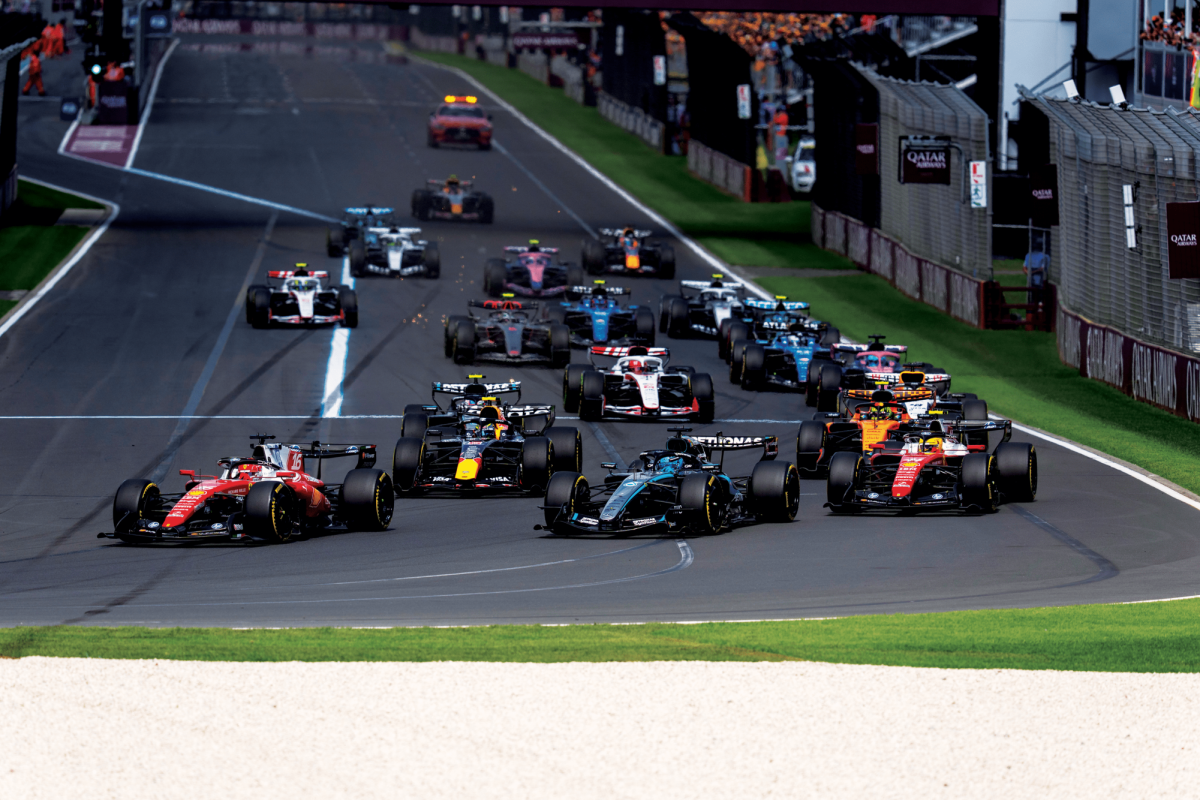
Every time a new regulation cycle comes to Formula one, results are unexpected. In my time watching the sport since 2018, this is the second major change I’ve witnessed, and certainly the biggest. Following four seasons of hit-or-miss ground-effect aero regulations, the Federation Internationale de I’Automobile has thrown everything but the kitchen sink at the sport to make the cars race better.
Drag Reduction System is dead, and in its place comes active aero, where the front and rear wings still use the same technology of movable aero devices to reduce drag on the straightaways, now open for use at any time instead of in designated sections. But the thing everybody is focusing on is the new engine regulations.
Formula One, since 2014, has used V6 turbocharged hybrid engines to power its cars, but while the general idea remains the same, new tech is introduced for 2026. The MGU-H has been done away with, the MGU-K gets a boost in power output and engine horsepower was slashed from 850 hp to 540 hp. Where is the other power coming from? Electrical batteries, of course, with 400 kW of energy coming from the ICE and 350 kW from the MGU-K battery.
Essentially, F1 has taken the keys from most major automobile manufacturers and dove headfirst into the world of EVs, with this specific engine cycle being the main bait to lure in Audi and, to an extent Ford and Honda, with the former never participating in Formula One and the latter two being long estranged.
Unlike a lot of other people, I really wasn’t miffed by the increased electrification of F1 for two reasons. First, I actually like Formula E (F1’s all-electric cousin), and second, similar tech has been used to great effect in sportscar racing. The old LMP1s of the 2010s and current Le Mans/Daytona Hypercars both used hybrid engine technology, and the racing in the FIA World Endurance Championship and IMSA SportsCar Championship has been amazing year after year.
Fast-forward to the Australian Grand Prix in March. I watched practice, and I watched qualifying, and my general consensus was, “wow, these new regulations are weird!” Notably, drivers were “superclipping” on the straightaways, which meant coasting and/or downshifting before braking zones. Drivers needed to recharge their batteries somehow, and this was the place to do it after they ran out down a long flat-out section. This made qualifying almost unwatchable, as the session in which drivers are meant to go full send for a lap still required saving energy like it was 40 laps into a stint in the race. As a result, my expectations for race day dipped quite a bit.
Then the actual race happened, and… it was pretty good! I thoroughly enjoyed the wheel-to-wheel action, with the lead drivers swapping places back and forth in the opening stages. However, in the back of my mind I knew a lot of these overtakes were down to battery management, and therefore not 100% skill-based. How legitimate is an overtake if the car in front is slowing down because its battery is running out?
Then again, how legitimate is an overtake if the car behind is 20 mph faster because it opened a flap in the rear wing? That’s what DRS did, and fans accepted that as a part of F1 in the past decade.
This isn’t me saying that the current F1 regulations are “actually good, though.” The superclipping is a load of nonsense, and the 50-50 split between natural engine and battery power needs to be fixed. At the Japanese Grand Prix in late March, the sport was also exposed to some of the newfound danger of superclipping and battery regen, as Oliver Bearman suffered an almighty shunt in his Haas F1 Team after having to swerve out of the way of Franco Colapinto’s Alpine F1 Team, which was slowing down for a corner early to conserve some battery life.
The negatives of the engines are obvious. However, the new aero regulations are awesome! For years, F1 fans complained that the cars were too big, and even though we’re back to 2012-sized cars, they can follow each other way more, and the active aero that can be used by all cars at any time makes everybody a lot more equal compared to the crazy advantage DRS gave. Even though last year’s engines are too big to fit in this year’s car, if we could somehow make that work, I’d have no doubt in my mind that F1 fans would be loving this new season.
This is why I’m a little bit skeptical of people claiming that the 2026 regulations are “the death of Formula 1.” People were saying this back in 2014, too, when F1 threw out V8s for V6s that cut power, sound, and general aura. That 2014 season saw Mercedes-powered teams be clearly the fastest throughout the season, and many fans absolutely hated it! But, with the passing years, other teams were able to catch up, and the FIA tweaked certain rules to make the regulations better, and F1 is now more popular than ever. Compare the atmosphere at a race from 2025 to one from 2015, and it doesn’t exactly seem like the sport was dying.
Another issue that arises is that I honestly have no idea where F1 can go from here. The obvious answer would be to do what I described above: just tell the engine manufacturers to kick up the ICE power and kill some of the battery deployment to make superclipping less of a problem. But what if the engine manufacturers don’t want to? Audi basically killed its entire racing program just to get to F1, and something tells me that it wouldn’t be too happy changing its engines that it lobbied for so soon. General Motors is also reportedly developing a bespoke Cadillac engine, so how would it like it if the FIA came to its doorstep and said, “You know all that work you’ve been doing to build an engine? Well, we’re changing the rules –– blow the whole thing up and start over.”
On April 20 the FIA, teams and manufacturers all got together and decided on a few rule changes to hopefully fix some aforementioned issues. Principally, the superclipping issue has been somewhat mended, with the limit being increased from 250 to 350 kW, meaning drivers can recover energy at full throttle. This will have a knock-on effect of making the cars slower overall, but the speed of the cars doesn’t necessarily equate to the racing being good. Look at the lap times from F1’s “peak” in the ‘90s compared to now for a sense of what I mean.
Does this mean F1 isn’t cooked anymore? I don’t know. It’s hard to even say whether F1 was cooked to begin with. The changes mentioned above are minor, relatively speaking, and a lot of the major issues (like superclipping existing in the first place) may end up becoming the norm and begrudged, like DRS. There is one positive from this brouhaha, however: elitist F1 fans are finally watching racing that isn’t F1! After years of deriding series like IndyCar, Super Formula and the World Endurance Championship for being scrub categories for F1 rejects, suddenly fans are slobbering over highlights of their races on social media. Just don’t tell them that WEC and IndyCar both have hybrid power or their heads might explode.
See you in Miami for F1’s next race on May 3! Hopefully it won’t stink!