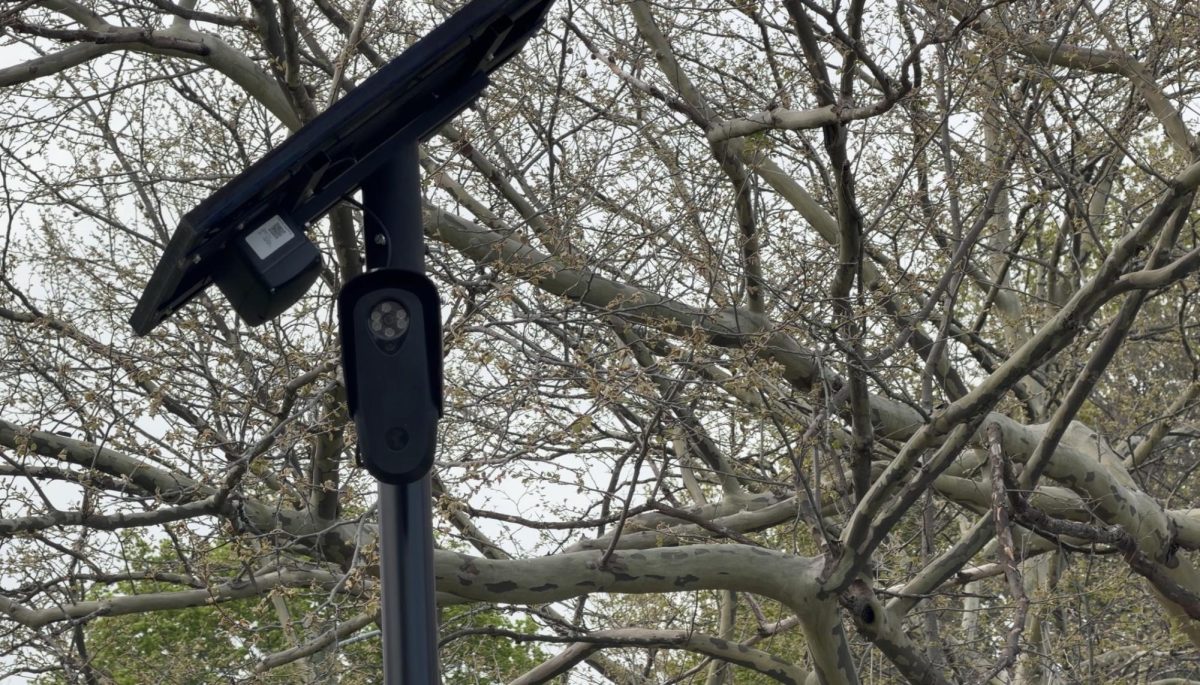
On April 22, posts on the anonymous campus app Fizz alerted Central Connecticut State University students to the presence of four automatic license plate reader cameras around campus. The posts, which included maps of camera locations and information about the company providing the technology, quickly spread among students, some of whom said they were unaware of their existence or purpose.
The cameras, operated by the CCSU Police Department, are located on Wells Street in front of Maloney Hall, at the entrance of Kaiser Drive, along Ella Grasso Boulevard across from the Balf-Savin Field lot and at the corner of East Street and Paul Manafort Sr. Drive.
Automatic license plate reader cameras, commonly known as ALPRs, are designed to capture and store images of passing vehicles and their license plates, allowing law enforcement agencies to track vehicle movement and investigate crimes. The cameras used at Central are part of a system provided by Flock Safety, a company that supplies ALPR technology to police departments across the country.
While the technology is often promoted as a public safety tool, its presence on campus, along with the lack of widespread awareness among students, has raised questions about surveillance, data collection and who has access to it.
Allison Mikosz, a Central student, said she was surprised to learn about the cameras and questioned whether they would actually make students feel safer.
“I think students should be able to enjoy their education without feeling like they’re being watched or unsafe just walking around campus,” Mikosz said.
A report from the American Civil Liberties Union, or ACLU, found that data collected by license plate reader systems has been accessed by federal immigration authorities, including Immigration and Customs Enforcement, or ICE, through partnerships with local law enforcement agencies. The report also noted that companies like Flock Safety allow police departments to search license plate data across a nationwide network.
In Connecticut, a report released in February by CT Insider found that out-of-state law enforcement agencies have searched data collected by license plate reader systems thousands of times, with some searches labeled “ICE” or “ICE-assist.” The report also found that police in Texas searched Connecticut data for a woman it said had an abortion, though officials said the search was not part of a criminal investigation.
Mariyah Shaikh, another CCSU student, said the possibility of outside access to ALPR data was troubling.
“I don’t like that,” Shaikh said. “I think that’s weird, especially since there are a lot of international students and the campus itself is very diverse. With ICE, they could use that in a bad way, and it’s just not safe.”
Gus Marks-Hamilton, advocacy and organizing manager with the ACLU of Connecticut, said that although the group recognizes ALPR cameras can help law enforcement in certain cases, such as stolen vehicle investigations or missing person cases, it is more concerned about how the data can be used over time to build a broader picture of people’s daily routines.
“When you have cameras that are taking pictures of everybody, every single day, multiple times a day, you begin to create patterns of movement,” Marks-Hamilton said. “People typically have the same activities from day to day or week to week, and if you know where people are at a particular time and location, you can begin to make predictions about where they’re going to be in the future.”
He said ALPR cameras differ from red light and speed cameras, which have expanded across Connecticut since a 2023 law allowed municipalities to install them. Those systems are typically triggered by specific violations, such as running a red light or speeding. In contrast, ALPR systems continuously capture images of every vehicle that passes by, collecting large volumes of data.
“These things are taking pictures of us and essentially tracking where we go,” Marks-Hamilton said. “Not having any public input about that is incredibly troubling.”
He said that unlike red light and speed cameras, which require public hearings and input before being installed, ALPR cameras are often deployed through contracts between law enforcement and private companies with little public involvement. Marks-Hamilton said that lack of oversight is due in part to the absence of clear statewide policies governing how the technology is used.
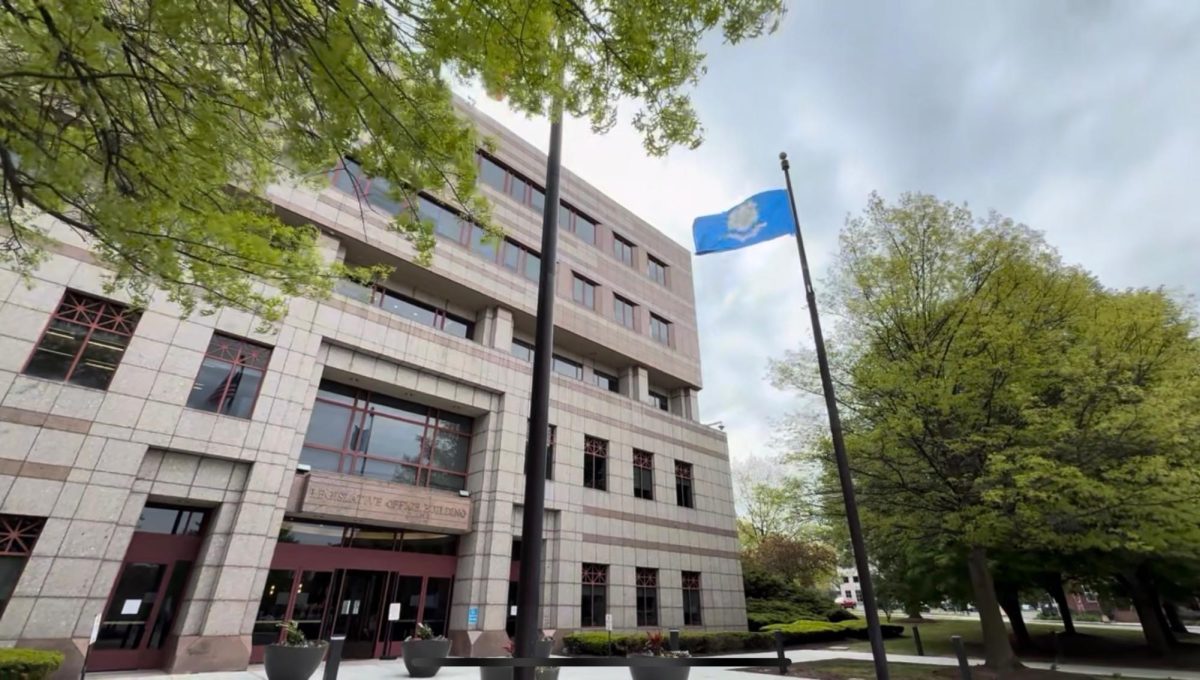
The ACLU of Connecticut is now pushing for new legislation aimed at regulating how ALPR data is collected and used across the state. The proposed legislation would limit how long license plate data can be stored and restrict access to law enforcement agencies within Connecticut and neighboring states. It would also require stronger safeguards for how the data is shared with outside agencies.
In a statement, CCSU Public Safety Director Chief Sean S. Grant, who oversees the university’s police department, said the system already includes restrictions on how the data can be used.
“Central’s police department ALPR data can only be shared with Connecticut law enforcement, no federal agencies,” Grant said. “The company who provides the CCSU Police Department ALPR technology prohibits using this technology for immigration cases or for tracking reproductive and gender-affirming health services.”
Jodi Latina, Central’s associate vice president of communications and media, said the university follows the Police Officer Standards and Training Council’s ALPR model policy, which outlines rules for how the technology can be used, who can access the data and how it must be managed.
Despite reassurances from university and police officials, questions about the cameras remain among students and advocacy groups. House Bill 5449, legislation backed by the ACLU of Connecticut that would place new limits on how ALPR data is used and shared, is expected to continue moving through the legislative process this year.