In late August of 1987, Patrick Sellers arrived on the Central Connecticut State University campus with nothing but a few bags and an uncertain future.
“I remember… mom dropping me off, making my bed in Vance Hall and leaving,” Sellers said. “I’m like, ‘Is that it? You’re leaving me?’ And she left me.”
With nowhere else to turn, he did what came naturally. He walked to Detrick Gymnasium, met a few teammates he barely knew, and jumped into a pickup game. What he didn’t realize then was that 38 years later, he’d be back in that same gym, this time as the head coach of the very team he once played for.
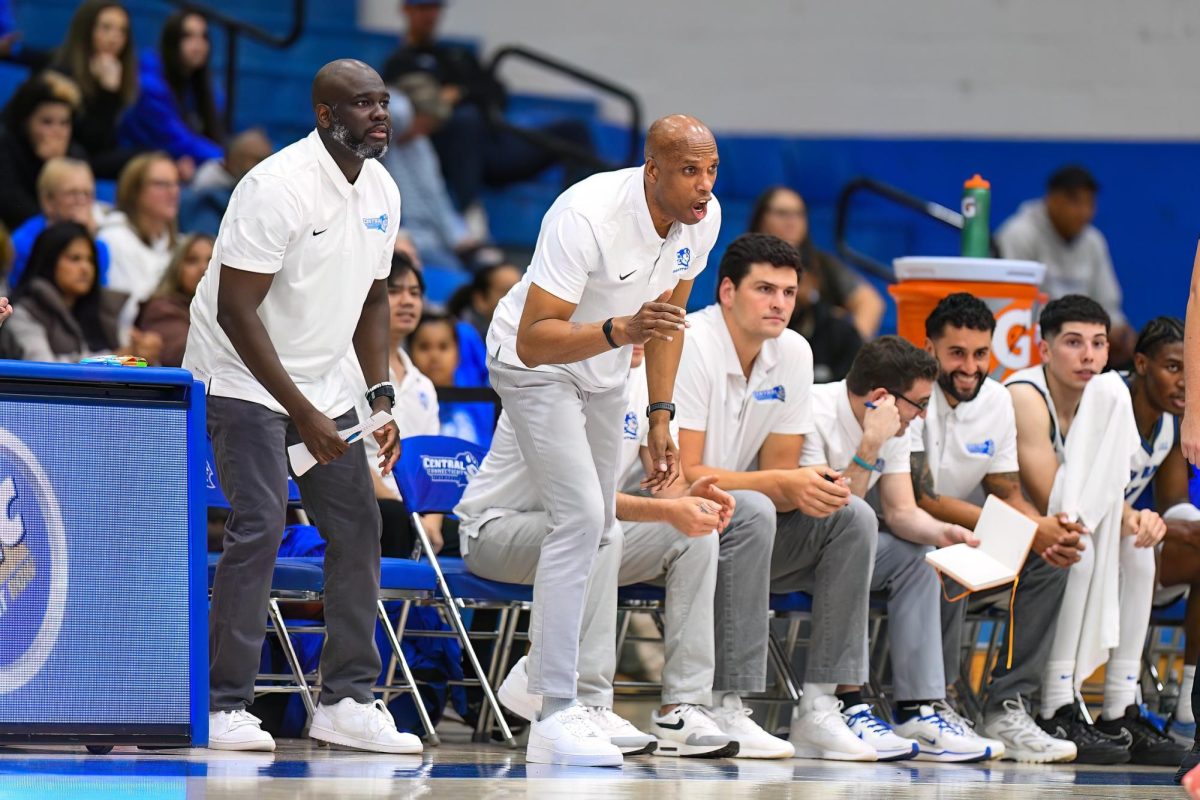
In 2021, Central hired Sellers to take over its struggling men’s basketball program. The decision paid off. Just four seasons later, he has revitalized the Blue Devils, leading them to back-to-back Northeast Conference regular season titles and their first appearance in the conference championship game since 2007. For his efforts, he earned consecutive Jim Phelan Northeast Conference Coach of the Year honors in 2024 and 2025.
And the future only looks brighter.
What makes Sellers’ rise so remarkable is that, despite a long and accomplished coaching career, he didn’t become a collegiate head coach until 2021. By that point, he had spent more than 25 years as an assistant coach, working under Hall of Famers, recruiting future pros, and helping build winning programs at nearly a dozen schools. He coached in packed out arenas and empty gyms, across mid-majors and high-majors, from Connecticut to China. And yet, for decades, he remained one seat over, never the one calling the final timeout, never the face of the program.
So how does someone so seasoned, so prepared, wait so long for a chance to run his own program?
To understand why it took so long, and why Sellers was ready when the opportunity finally came, you have to go back to where his coaching journey really began, right after graduation, when his playing dreams were suddenly thrown off course.
Sellers graduated from CCSU in 1991 after a four-year career with the Blue Devils. Known for his toughness and court awareness, he was named East Coast Conference Defensive Player of the Year as a senior.
While many players leave college unsure of their next move, Sellers already had a clear vision.
“I knew I was going to coach,” he said. “Even when I was a player… I knew it wasn’t going to last forever, and I wanted to be around basketball.”
After graduating, Sellers stayed at CCSU as a graduate assistant under new head coach Mark Adams. At the same time, he was drawing interest from the United States Basketball League (USBL), a professional men’s summer basketball league. At the time, the USBL was considered a developmental league, giving players a chance to earn a spot on an NBA or Continental Basketball Association (CBA) roster.
But just as Sellers was preparing to take that next step and play in the USBL, he suffered a major setback, breaking his ankle during an offseason workout. The injury sidelined him for an extended period and ultimately cost him not only a shot at playing in the USBL, but also his best chance of making it to the NBA.
However, Sellers’ dream of playing professionally wasn’t over just yet. As he recovered from his injury and worked his way back into shape, he began participating in basketball training camps. At one of these camps, hosted by UConn, he was spotted by Tony Hanson, a former UConn standout who was then serving as a player-coach for the Tees Valley Mohawks, a top-tier professional basketball team in England.
Hanson recruited Sellers to join him overseas.
“Tony called me and said, ‘Hey man, I think I have an opportunity for you here. We got out to a really slow start in England, and we need to bring a foreigner over. Would you be interested?’” Sellers recalled.
With Coach Adams’ blessing, Sellers packed his bags and left for Middlesbrough, England, ready to finally begin his professional playing career. In his first year there, the Mohawks went to the British Basketball League championship.
Despite early success in England, Sellers soon suffered another setback, an injury to his iliotibial (IT) band that required surgery. After dealing with two significant injuries in a short span, he began to realize that his playing career might be nearing its end. Around that time, a friend offered him an assistant coaching job at St. Thomas Aquinas High School, a Roman Catholic school in New Britain.
Sellers had a deal lined up to play in Sweden, but he began to question whether it was worth continuing to chase short-term contracts overseas. The opportunity to start building a coaching career, back home, in a familiar community, proved too compelling to ignore.
“I just put two and two together,” Sellers said. “Am I going to keep going to Sweden, England, messing around, or is it time to get my career started? So, I just chose the career part of it and came back and started coaching high school.”
Sellers spent the next five years (1994–1999) coaching at St. Thomas Aquinas High School. He began as an assistant coach for three seasons before being promoted to head coach for his final two years with the program.
He said his coaching journey truly began at Central Connecticut under Coach Howie Dickenman, a figure he credits as a major influence.
“It all started here,” Sellers said. “It all started with Coach Dickenman at Central Connecticut.”
Dickenman, a respected name in college basketball circles, had served as an assistant at UConn under Jim Calhoun, where he played a key role in recruiting standout players like Ray Allen, Donyell Marshall and Sellers’ younger brother, Rod Sellers. When he returned to his alma mater to take over the head coaching job at CCSU, he brought Patrick Sellers on board near the end of his high school coaching tenure.
Sellers, who was transitioning from coaching at the high school and AAU levels, admitted he was still “young and green” when he arrived. But under Dickenman’s guidance, he said he quickly learned the importance of detail.
“I learned so much,” Sellers said. “When you’re recruiting a player, we had to know his guidance counselor, his favorite food, who’s his favorite player, what does he like to do. We had to know every little detail, and when we did the scouting report, we couldn’t leave any stone unturned.”
That experience, Sellers said, laid the foundation for the rest of his career.
“When I left to go to UMass and then UConn and Creighton and all the other places, everything was easy,” he said, “because my upbringing was four years of working at Central Connecticut with Coach Dickenman. It really prepared me.”
During Sellers’ four-year stint as an assistant at CCSU, the Blue Devils captured Northeast Conference regular season and tournament titles in both 2000 and 2002. The program also earned NCAA Tournament berths in each of those championship seasons.
Sellers departed Central in 2003 to join the coaching staff at UMass, marking the beginning of a nearly two-decade journey through the ranks of college basketball. After one season in Amherst, he returned to his home state to join the University of Connecticut, initially serving as director of basketball operations from 2004 to 2007. In 2007, he was promoted to associate head coach under Hall of Famer Jim Calhoun, helping guide the Huskies through multiple NCAA Tournament appearances.
But the grind of recruiting at the high-major level eventually wore him down. The constant travel, calls and pressure meant he was no longer enjoying the game the way he once had. So in 2010, when the opportunity came to coach professionally in China, Sellers saw it as a chance to reset and reconnect with what he loved most, the game itself.
“China came at the right time,” Sellers said. “At that point, I had been recruiting for so long… recruiting was nonstop, 24/7, especially when you’re at a high-major situation.”
He joined the coaching staff of Shanxi Zhongyu in the Chinese Basketball Association, where he found a renewed sense of purpose. The job re-ignited the love he had for the game.
“China was just refreshing because it ended up being all basketball. It was a chance to coach pros… and it was just strictly basketball, no recruiting,” he said. “It helped me sharpen my game. I would call up college coaches, NBA coaches. I was working on my game as far as out-of-bounds plays, what you do on defense, ball screens… all the little nuances.”
The roster was full of high-level talent. NBA veterans like Stephon Marbury and Jamal Sampson passed through the program, as did standout overseas players like Sam Douglas. Sellers also crossed paths with God Shammgod, now a player development coach with the Dallas Mavericks.
“[China] was just like a basketball clinic… from guys who played in the professional leagues, guys who knew all the tricks of the trade,” Sellers said. “I learned a lot that I was able to teach to younger guys when I got back to college.”
He left China in 2011 and returned to the world of college basketball, joining Hofstra’s coaching staff. From that point on, he worked exclusively as an assistant coach. His year overseas had reaffirmed something he already knew, that his place was on the court, not behind a desk or in a front-office role.
In 2016, while coaching at DePaul, Sellers saw a familiar opportunity arise, the head coaching job at Central Connecticut State University, his alma mater. As both a former player and assistant coach at CCSU, Sellers had deep ties to the program. He applied, interviewed and quickly became a serious candidate.
“One of my college buddies always said, ‘If you look back at Central Connecticut’s history, the guys who’ve been successful at this school have been Central Connecticut alums, guys who’ve played here,’” Sellers recalled. “‘They know the ins and outs of the school, they know what you’re working with, they know the strong points and they know the weaknesses.’ And so I said something like that in my interview too.”
But the university went in a different direction, hiring former NBA forward Donyell Marshall to lead the team.
“I think they believed in me [in 2016],” Sellers reflected. “It was just… a big former NBA player type guy that was hard to say no to.”
Although disappointed, another opportunity soon emerged, one that may have been even more appealing. The Houston Rockets, one of the NBA’s most storied franchises, offered Sellers a front-office position with elevated responsibilities in scouting and player evaluation, work that often serves as a stepping stone to long-term NBA careers.
For many, it would have been a dream job. But for Sellers, the position seemed like a step backward, requiring him to be away from the court and the action that he thrived off of. His time in China had reminded him of just who he was.
“I love working guys out. I love being in the gym,” Sellers said. “It’s hard to just be a front office guy and watch, take notes and make decisions. I want to be on the court and in the game.”
Still, out of respect, he flew to Houston to meet with then-Rockets general manager Daryl Morey. He had breakfast with members of the organization, including Nick Nurse, then head coach of the team’s G League affiliate. They suggested he could occasionally spend time on the court if he needed to “get his fix.”
But for Sellers, it wasn’t enough.
“I said, ‘Let me sleep on it,’” he recalled. “Then I flew back and said, ‘No thanks. I need to be on the court.’”
It was a defining moment, not just in his career, but in his clarity. For all the prestige the NBA could offer, Sellers never lost sight of what mattered most, coaching.
In 2021, five years after being passed over for the CCSU head coaching job, Sellers got a second chance, and this time, the circumstances were different. The university had a new Director of Athletics, Tom Pincince, who saw Sellers not just as a qualified candidate, but as someone uniquely equipped to rebuild the program from the ground up.
“[Tom] said, ‘Pat, you know the strengths and weaknesses of this school, so you know how to recruit with that mindset. We want guys like you,’” Sellers recalled.
This time, he got the job.
Sellers wasted no time establishing the identity he wanted for the program, unselfish, hard-working, and tough, just like the city it represented.
“New Britain’s a blue-collar town. That’s the place that we’re at, and so that’s what we recruited,” he said.
Several of the players Sellers brought in during his first year were already on his radar from his time at Fairfield or had been recommended by coaching contacts. From the start, he could tell they were the right fit.
“We knew right at the beginning that these guys were really good kids,” Sellers said. “We knew that they were hard workers, and they were hungry to prove to people that they were overlooked, and that fit what we were looking for. That blue collar, underdog mentality.”
In his first recruiting class, Sellers brought in eight players, four of whom would stay with the program through all four years: Jayden Brown, Joe Ostrowsky, Devante Sweatman, and Abdul Momoh.
In Sellers’ first season with his new team, the Blue Devils went 8-24. In his second, they improved slightly to 10-22. The progress was modest, but the foundation was starting to solidify.
“We were new,” Sellers said. “We were growing as a staff and they were growing as players. So we had to figure things out in both of those years.”
While the win totals remained low, the team was far more competitive than the record suggested. In Year 2 alone, Central lost nine games in which it led during the second half, many of them by just a possession or two.
“If you win those games, you’re looking at 18 or 19 wins,” Sellers said. “We knew we were close.”
That belief never wavered. Inside the locker room, the message stayed consistent. Players were buying in. The system was working. They just needed time.
“We’d come into the locker room, have our team meeting, watch the film and say, ‘Hey fellas, we’re this close,’” Sellers said. “‘We’re this close to being 5–4 instead of 0–9.’ I told them, ‘That’s a big difference… The stated course is going to turn for us,’ and eventually, it turned.”
Year 3 was when all the pieces finally started to come together for Sellers and the Blue Devils. It was also the year that saw the arrival of Jordan Jones, a high-motor guard who would become a cornerstone of the program. Like Sellers, Jones hailed from Florence, South Carolina, a connection that made their bond even stronger.
With a maturing core of four-year players and a new leader in Jones, Central took a major step forward.
In the 2023-24 season, the Blue Devils jumped 10 wins to finish 20-11. It was their first winning season since 2010-11 and clear evidence that Sellers’ blueprint was working. Central captured the Northeast Conference regular season title and advanced to the conference tournament semifinals.
The transformation didn’t go unnoticed. Sellers was named NEC Coach of the Year, a recognition of both the team’s success and the rebuild that made it possible.
And while the Blue Devils fell short of the conference finals, the momentum was undeniable. The culture was in place, the foundation was solid and the belief was growing. The stage was set for what would become an even more historic season.
Building on their first winning year in over a decade, the Blue Devils returned in the 2024-25 season with experience, depth and belief. They didn’t just maintain their momentum, they elevated it. Central finished the regular season 25–7 and captured their second consecutive Northeast Conference regular season title for the first time in program history.
The accolades reflected their dominance. Jordan Jones was named Northeast Conference Player of the Year, becoming the first Blue Devil to win the award since Ken Horton in 2012. Abdul Momoh, one of the original recruits from Sellers’ first year, was named NEC Defensive Player of the Year.
And Sellers was once again awarded NEC Coach of the Year, further cementing his role in one of the program’s most impressive turnarounds.
Riding the nation’s longest active winning streak at 14 games, Central returned to the NEC championship game for the first time since 2007, playing in front of a packed gym in New Britain. But the dream ending slipped away in a 46–43 loss to Saint Francis (PA).
The text messages came pouring in.
“After that St. Francis, PA game, I got a million texts,” Sellers said. “‘Oh, sorry about the loss,’ blah blah blah. ‘Great season,’ this and that.”
But Sellers didn’t dwell on it, and he didn’t want his players to either. He thought back to his time at UConn, when his team lost a six-overtime thriller to Syracuse, and associate head coach George Blaney told them something that stuck with him for years: People are going to talk about this game for the rest of your life.
So that’s exactly what Sellers told his team.
“I said something similar,” he recalled. “I said, ‘Hey man, you guys [are] gonna always be remembered. You had a great year, blah blah blah. It didn’t go the way we wanted it, but… the beauty of basketball is you got the next season.’”
For some, that next season will mean another year in a Central uniform. For others, it may come as a pro player or coach. Either way, Sellers wanted them to know this wasn’t the end, just another step in the journey.
That included himself, already shifting focus to what’s next.
“People would call me and ask, ‘Are you OK?,’” he said. “And I’m like, ‘Hey man, the next season is upon us. We’re working on putting together the roster so we can have another fun run and exciting time.’”
Nearly four decades after walking into Detrick Gymnasium as a freshman with no idea what lay ahead, Patrick Sellers now walks in with purpose, not just as a head coach, but as the heart of a program he helped build, lost, and brought back. The dream didn’t end with a final score. It lives in what comes next.