It’s rare for a movie about the end of the world to feel uplifting, but Project Hail Mary manages to do exactly that. Based on author Andy Weir’s 2021 hard science fiction novel of the same name, the film was released on March 20. Directed by Phil Lord and Christopher Miller, it has already climbed to a 94% rating on Rotten Tomatoes, and for good reason.
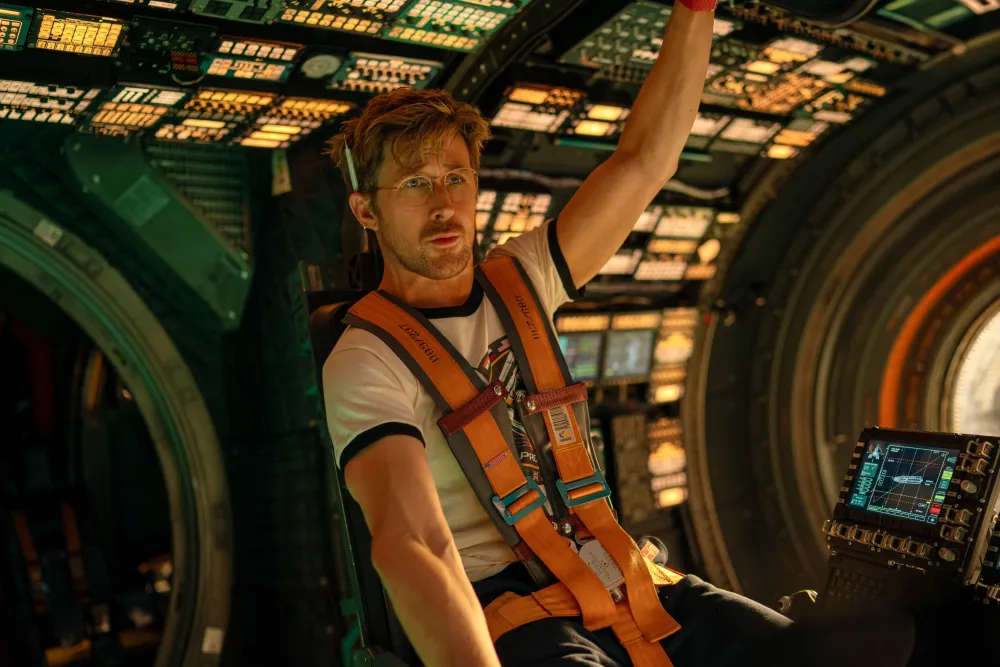
The film stars Ryan Gosling as Ryland Grace, a middle school teacher and former biologist who wakes up on a spaceship with no memory of how he got there. He soon discovers the terrifying reality: A microscopic organism called an astrophage is consuming the sun’s energy at an exponential rate. If left unchecked, Earth will be plunged into a permanent ice age, leading to total extinction within decades.
The scope of the disaster is staggering. It isn’t just our solar system that’s affected, but every nearby star. The only exception is the Tau Ceti system, which remains mysteriously unaffected. Through a series of unfortunate circumstances, Grace is chosen to travel across light-years to Tau Ceti in hopes of discovering the secret that could save humanity.
But, as it turns out, humans aren’t the only ones trying to save their planet.
While that sounds like a heavy premise, the film avoids the usual doom and gloom of space dramas. Instead, it leans into humor, curiosity and human connection, creating a tone that feels genuinely positive. Much of that success rests on Gosling’s shoulders. He balances intelligence with vulnerability and just enough humor to keep things grounded. Rather than portraying a stoic “chosen one” hero, Grace feels relatable. He’s often unsure of himself, but driven by a teacher’s instinct to solve the problem in front of him.
The film finds its rhythm in the trial and error of the mission. The science, from orbital mechanics to the biology of the Astrophage, never feels overwhelming. Instead, it’s presented as a series of puzzles. Watching Grace use basic logic and makeshift tools to solve complex interstellar problems makes you feel like you’re learning alongside him, rather than being lectured at.
But the emotional heartbeat of the movie is Rocky. Without giving too much away, Rocky’s presence adds an entirely new layer to the story. The chemistry between him and Grace is easily the strongest part of the film. Through sound design and subtle physical expression, their relationship turns what could have been a straightforward survival story into something much more meaningful, about trust, communication, cooperation and a friendship that crosses the boundary between species.
What ultimately sets Project Hail Mary apart is its optimism. In a genre often dominated by destruction and despair, this film chooses to focus on resilience and intelligence. It suggests that humanity’s greatest strength isn’t just our will to survive, but our ability to work together and adapt under extreme circumstances.
By the time the credits roll, what lingers isn’t just the high-stakes outcome of the mission, but the sense of hope built along the way. It’s a rare kind of sci-fi story, one that leaves you thinking, but more importantly, feeling.
So, when it comes to Project Hail Mary, it’s not half bad. It’s full good.