This July, Central Connecticut State University will submit a proposal to transition to a Research 2 (R2) polytechnic university to expand resources and academic opportunities, according to President Zulma R. Toro.
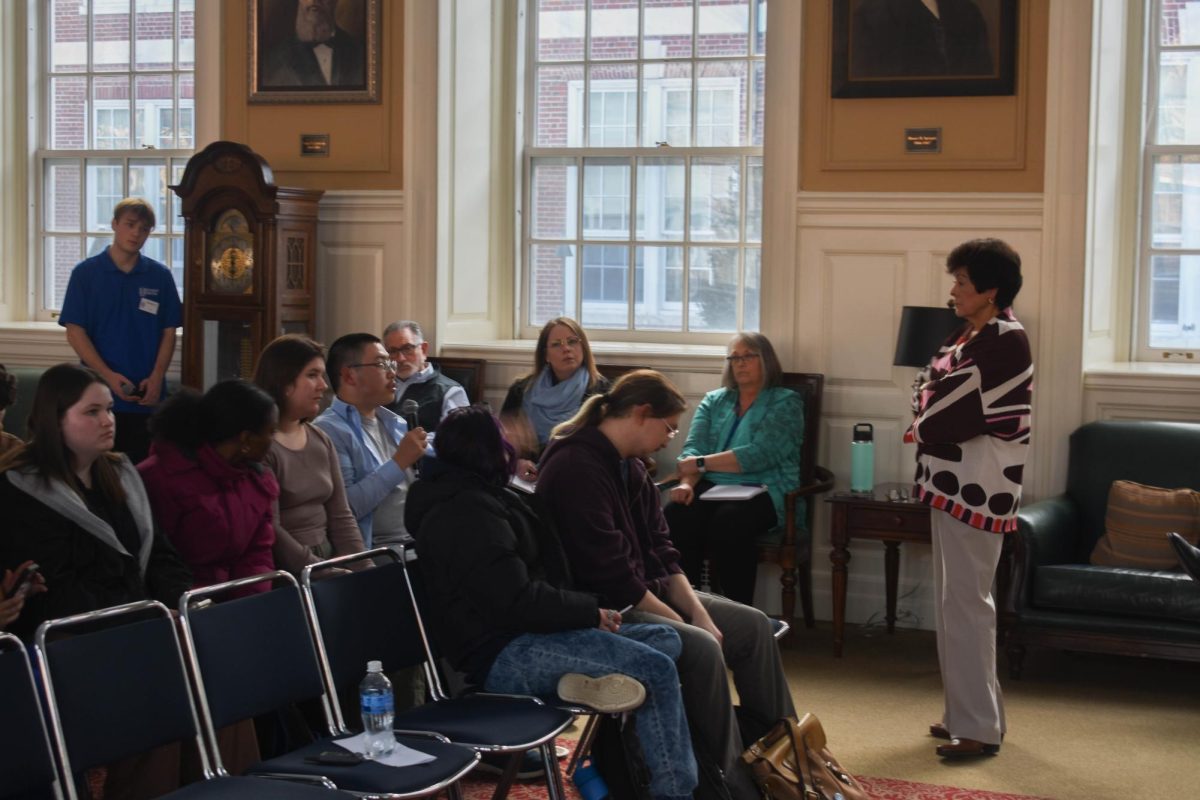
Announced at an open forum on Feb. 17, CCSU is not only seeking to strengthen the school’s STEM programs and offer more experiential learning but also to obtain the R2 designation, which would put it on par with institutions such as Southern Connecticut State University.
A polytechnic university differs from a traditional university in that it emphasizes applied learning and immediate employment after graduation.
The requirements for an R2 designation include at least $5 million spent on research and development, as well as at least 20 doctoral research degrees awarded in a single academic year, according to the Carnegie Classification of Institutions of Higher Education.
The shift would be felt beyond the Connecticut system. If approved, CCSU would become the only public polytechnic university in New England.
During her presentation, Toro cited seven pillars that would serve as the foundation for the change.
With a core focus on the Colleges of Engineering, Science and Technology and the College of Health and Rehabilitation Sciences, the proposal includes plans to create additional labs to facilitate more opportunities for hands-on learning.
Toro repeatedly emphasized during the forum that the College of Liberal Arts and Social Sciences will remain central to the university’s mission. However, students and faculty alike raised concerns about the potential effects of the change.
Central Workforce, the Innovation Hub, Applied Research and the Central Talent Development Framework were among the pillars described, reinforcing the idea of workforce readiness after graduation.
One proposal would require a mandatory internship as an additional graduation requirement for every student.
Although the presentation resonated with some attendees, several students from different disciplines spoke in opposition during the open-mic segment.
A CCSU psychology and sociology major spoke at the town hall to share her disapproval of the change.
“I am deeply troubled by the shift toward prioritizing STEM and vocational programs at the expense of the liberal arts,” she said. “CCSU has a long history as a public, accessible and liberal arts institution. It is a place where students learn to think critically, to engage with society and to develop skills that go beyond the job market. These values are not just academic ideals; they are the foundation of a well-rounded education that prepares students to participate meaningfully in the world.”
She went on to echo concerns shared by other students.
“Initiatives that have been supported for Diversity, Equity and Inclusion (DEI) have been reduced or eliminated, despite the fact that peer state universities appear to uphold them,” she said. “These moves are not just administrative; they are fundamentally changing the character of CCSU and making it less inclusive, less thoughtful and less of the university it’s always been.”
In her response, Toro denied any regression of DEI initiatives and cited herself as evidence of the university’s commitment to diversity.
CCSU’s student body is 43% minority and 47% women, according to the university’s “At a Glance” report. In contrast, Worcester Polytechnic Institute has a minority population of about 23%, and women make up about 34% of its student body.
From the STEM perspective, students raised concerns about not having enough professors in their programs, as well as a lack of appropriate course options for their majors.
Some students voiced support, while others expressed appreciation for their collegiate experience at CCSU. Toro said the benefits would extend beyond additional campus resources, arguing that the shift would attract more students from across the country and abroad. She added that the move would help improve public perception of the CSCU system by bringing greater prestige.
The transition would not require a complete overhaul of existing infrastructure. Toro said CCSU may be closer to meeting R2 requirements than initially anticipated.
“I was told this morning by the provost, who is working those numbers, that we have been underestimating for many years the amount of money that we spend in research,” she said. “Because all the research that is done by faculty that is paid by the state has not been considered. And that’s a lot of money.”
Toro, in conjunction with a carefully selected task force, is overseeing the process. The Faculty Senate has pushed for transparency through online records of the task force’s meetings and has requested representation on the task force, according to Faculty Senate President Stephen Adair.
“We are just starting the process … we have a lot of work ahead of us,” Toro said.
If the proposal is approved, CCSU would debut as a polytechnic university in the fall 2027 semester.