
“Webster’s Bitch” offers an amusing exploration of the various meanings language can hold through a critical and feminist lens.
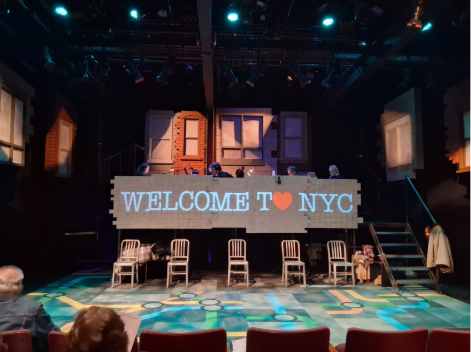
Performed in the Black Box Theatre at Maloney Hall at Central Connecticut State University from March 5-8, the play follows Gwen (Nicole Sweet) and Nick (Edward Antigua), two lexicographers for Webster’s Dictionary who find themselves in a conundrum when Gwen’s sister Ellie (Brooke Hendon) informs them of a viral Twitter video in which their supervisor Joyce (Mia Lozada) is being called a “bitch” by the dictionary’s editor-in-chief, Frank (Derek Lopez), while at a conference.
What follows is a series of debates over how the word in question should really be defined and the workplace politics surrounding it. Each of the characters working at Webster’s has a lot of personal stakes in their job, and this new controversy is the tipping point that causes many of them to boil over.
From Gwen wanting more appreciation and compensation for what she has done and continues to do, to Nick not wanting to be blamed unnecessarily for doing his job, to Joyce holding on to lingering resentments for the previous editor-in-chief while seeking better career options, to Frank desperately wanting to keep his position in the aftermath of what he said, each of them has something to fight for. This causes them to butt heads with one another as the situation unfolds around them.
There is comedy in this play, as the situation is rather absurd, poking fun at how wildly fast things can spiral out of control on the internet. At the same time, it asks the audience to consider what that means. In a time when people’s words and actions can be made publicly known almost immediately and responded to in turn, what should the reaction be and how big should it be?
Additionally, how long is it relevant? When the video initially surfaces, it draws massive criticism from certain feminist circles on Twitter. The situation online and in the Webster’s Dictionary office changes slightly when a BuzzFeed article clarifies that Frank had not said “Joyce’s a bitch” but “Joyce is my bitch.” The internet’s attention is then further diverted when J.K. Rowling tweets about there being a Hogwarts on the moon.
Internet trends and controversies can be fleeting as people jump to the next thing that catches their attention. We often do not think too much about the aftermath for those involved once it is deemed no longer relevant.
The play, in turn, shifts from the characters trying to deal with the massive backlash the dictionary is facing from people online to resolving the issue internally. Even with them out of the spotlight, they still feel they have a moral responsibility to update their definition of “bitch” to assuage any doubts about them as a language resource.
The ever-evolving meaning of language is another major element of the play. Several times, Gwen goes on a rant about how they have a duty as a dictionary to keep their definitions up to date because of the flexible nature of language. The initial definitions of “bitch” that the dictionary had on its website seemed sufficient at the time, but with people everywhere arguing about it, Joyce demands Gwen and Nick come up with more specific ones.
The way we view language, be it a playful, neutral tease in one context or a slur in another, is constantly in flux and important to be aware of. This is especially the case for an institution like Webster’s Dictionary, but also for the average speaker of a language.
Another interesting aspect of the play is feminism in the workplace. Gwen is very frustrated with how reductive the initial definition of “bitch” is and how she feels she is not being compensated fairly for all her work. Joyce comes across as a very typical domineering and aggressive female boss to Gwen and Nick, though part of her behavior stems from the sexist environment she previously worked in at Webster’s. Ellie is a vocal advocate for menstrual health and rights, who urges Gwen to leave her job due to the treatment she is receiving. This play gives audiences a lot to think about regarding how women are treated in the workplace, especially in white-collar jobs.
Each of the cast members gives performances that are fun and engaging. Every character has a great sense of pathos. You can sympathize with each person’s viewpoint at times or disagree with them at others. They all feel like very real people stuck in a situation where there is no clear-cut, black-and-white answer.
Lozada, in particular, is as vivacious and fiery as Joyce. She commands attention in every scene she is in. Sweet gives Gwen a passionate performance with hard-hitting line deliveries that sell how stuck and frustrated Gwen feels in the situation. Lopez, as Frank, is interesting to watch in the limited time he is onstage, portraying a frantic, two-faced personality.
“Webster’s Bitch” asks audiences to consider the power that language can have and how that power is affected by changing definitions. Sensibilities change as time passes, and we must keep up with them. The internet has certainly exacerbated things in recent years, but it is an issue we continue to face every time we speak.
Black Box Theatre’s next performance will be “In Pieces” from April 30 to May 3.