
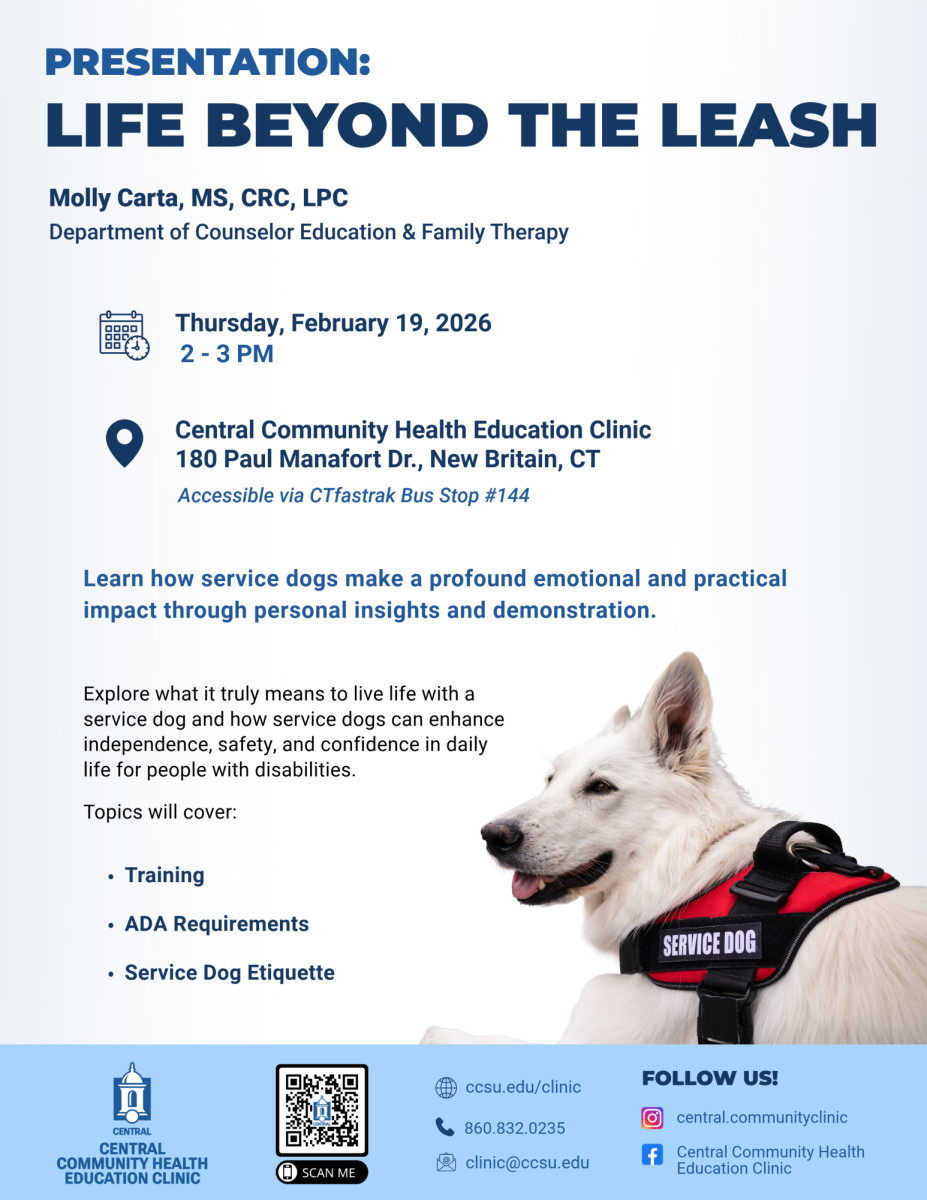
For many students, service animals are something they may see around campus but might not fully understand. During a recent presentation delivered by adjunct professor Molly Carta, she turned curiosity into clarity, walking students through the complex process of obtaining a service dog and offering a firsthand account of what it means to rely on one every day.
Alongside her was her Lab-Golden crossbreed, Slate, her service animal provided by the organization Canine Companions. Slate is 3 1/2 years old and loves long walks and lamb chop toys, but he also has an important job.
Slate is a trained service animal, taught to perform tasks that accommodate Carta’s physical disabilities. He is trained to complete a variety of tasks, such as picking up items, opening and closing doors, and turning on light switches.
These tasks make life possible for people with physical disabilities. Carta explained the rules of having a service dog, including where they can go, everywhere except sterile hospital areas. Churches and other religious institutions reserve the right to deny a service animal in their space.
Carta also emphasized the importance of knowing the difference between a service animal and a therapy animal.
“Four on the floor” is a saying Slate and other service animals are taught.
“[Slate] should not be jumping up, he should not be sitting in a seat, he really shouldn’t be doing anything … he should be invisible,” Carta said. “He should be under a table if I’m in a restaurant, or tucked away underneath me in a way that is not going to be in the way of anybody.”
Carta brought attention to the “gray area” in service animal legislation. Service animals are required to perform a task related to an owner’s disability, but these dogs can be privately trained.
Within the service animal community there are discussions about what makes a service animal a service animal, and the proper way to train said service animal.
“There’s a lot that goes into animal training, and the dog trainers are phenomenal individuals who put a ton of work into these dogs … and when you’re actively training your own dog, you don’t have that background,” Carta said.
There are dicey areas in the world of service animals and therapy or emotional support animals.
“ADA (Americans with Disabilities Act) says providing comfort and support is not a task directly related to a person’s disability. You could make the argument for PTSD or anxiety, but at the end of the day, comfort is not a task … comfort is a feeling or emotion, but not a task,” Carta said.
That is a key difference between the two. A service dog performs tasks that the owner cannot do.
“[Slate] knows 16 different words that can be translated into 60 different commands,” Carta said.