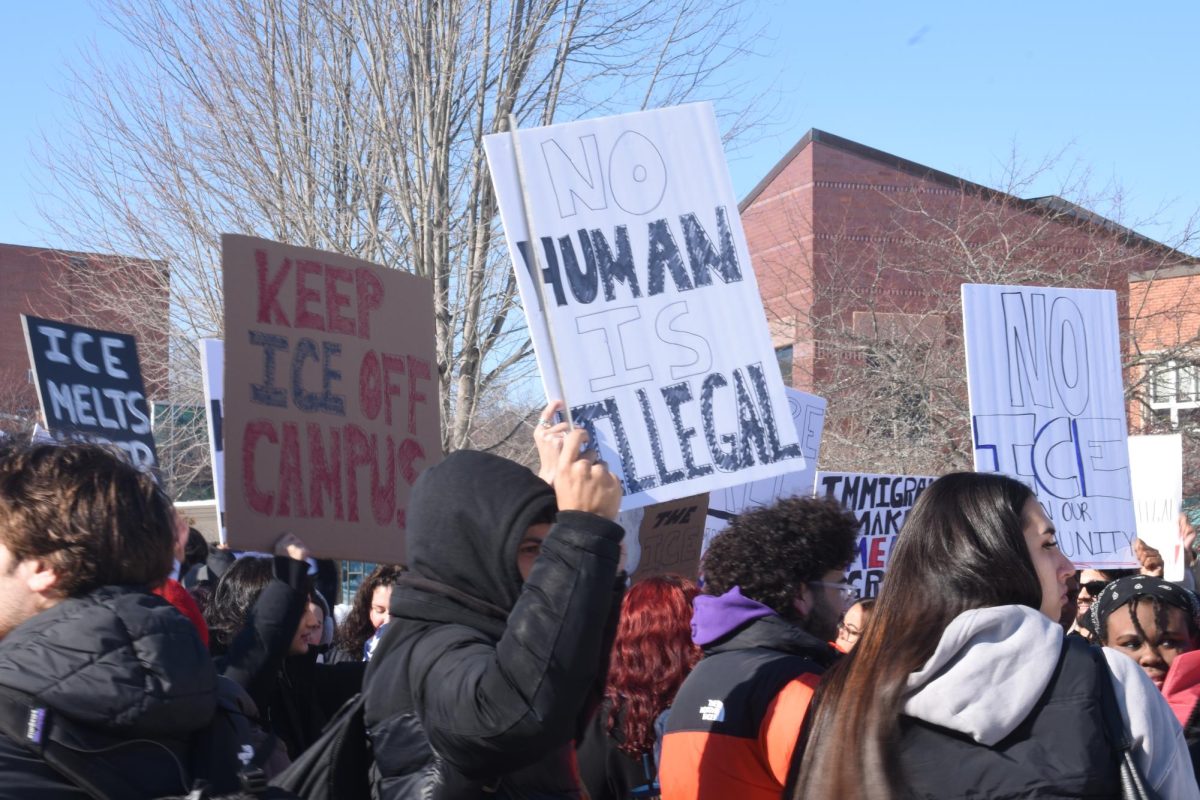
Chants echoing across campus marked an exercise in free speech as students rallied to protest U.S. Immigration and Customs Enforcement (ICE), advocating for protections immigrant classmates need and voicing concerns about federal enforcement policies.
The student-led demonstration became a visible moment of civic engagement, highlighting how national immigration debates are playing out within the Central community.
The event was organized by Emily Delgado, a student at CCSU, as an outlet for other students who feel the same way.
“I wanted to be heard, I know a lot of other students out here are feeling silenced and scared … and I want other people to know that there are other people in this community that are feeling the same way, and I’m here for you,” said Delgado.
Delgado started this process by approaching the dean of student life affairs to spark this movement.
“They had some ifs about it just because there were things we couldn’t do, we can’t protest inside, obviously there’s no hate speech …,” said Delgado.
This display of protest has caused discourse among faculty and students alike regarding the impact and importance of supporting a cause.
However, the movement was welcomed on campus by some of those who stopped to watch. Student Remy Dannucci was able to catch a glimpse.
“I feel very hopeful and I feel a little more connected to my school because people are coming together to focus on this one thing,” said Dannucci.
Another student, Rachael Case, was able to voice their opinion because of this protest.
“I don’t think ICE has any place here; no one was illegal on stolen land,” said Case.
This event initiated a conversation on campus. Michael Russo is a student who shares his experience as someone who is a part of an immigrant family.
“My mother is a first-generation immigrant to the United States … It’s a good message, people are people, everyone should be able to live a life within the country,” said Russo.
For a student like Russo, he doesn’t see the protest as black and white, but as a much more complicated conversation.
“But at the same time, I think of my grandfather, the struggles he had to do to get into the country, how it was a very lengthy process,” said Russo. “If you’re here illegally, then you’re not really paying many taxes … I understand your plight.”
In a statement from Connecticut State Colleges and Universities (CSCU), their position is clear: “CSCU is committed to social justice, to celebrating our diversity, and fostering a climate of inclusion and respect for one another. CSCU will continue to comply with federal and state law, and we will remain focused on what is truly best for our students and institutions.”
As for President Toro, she spoke on her stance by reassuring the CCSU community will stay equipped with the proper information to handle these situations.
“The current landscape is unpredictable and changes quickly,” Toro said. “We are working diligently with the Office of the Attorney General and the CSCU system office to ensure that we can provide you with all relevant information as it relates to our campus community. I will strive to keep you as informed as possible as we navigate this complex and evolving space.”
The protest may have ended, but the conflict it represents continues. For CCSU students, immigration enforcement is not a distant headline; it is a lived reality, one that ensures the debate over ICE will remain active both on campus and far beyond it.